 Cockapoo
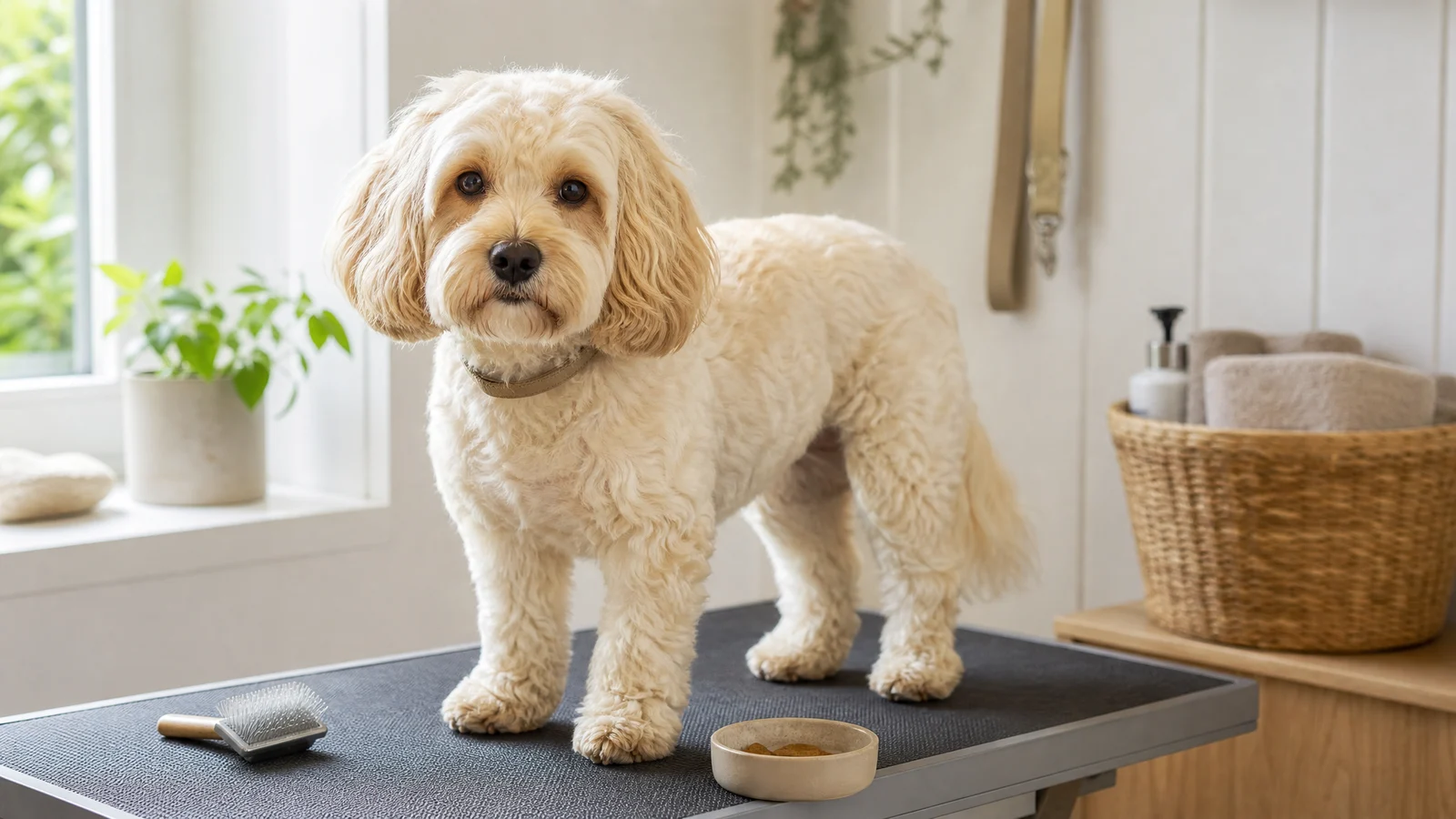
To groom a Cockapoo at home, keep sessions short and paced by treats, brush every day, and go slowly around the face and tail. The reason is in the coat. Both parent breeds score 4 of 5 for coat grooming frequency, and the advice for the Poodle side is to learn daily brushing to prevent matting, unless the dog stays in a short trim. In our work with this breed, calm handling has always done more for a coat than any single tool.
Your Cockapoo may inherit either coat or a blend, so plan for the harder one. Handling skill matters as much as tools. A dog who dislikes the brush gets brushed less, mats more, and then dislikes the brush even more. When calm handling is taught early, the dog gives back easy grooming days, shorter salon visits, and far fewer tangles to cut out.
Below, you'll find myth-by-myth answers on coat care, puppy practice, face trims, brushing consent, tails and groomer visits, including a day-by-day plan for your next two weeks.
The Myth That a Cockapoo Coat Needs Little Grooming
Many people choose a Cockapoo expecting a fluffy, low-shedding dog who needs only an occasional brush. The breed ratings say otherwise. On the scale used for both parent breeds, 1 means monthly grooming, 3 means weekly and 5 means daily, and both the Cocker and the Poodle land at 4.
That puts the expected routine closer to daily than weekly. The Poodle also sheds very little, rated 1 of 5 against the Cocker's 3, and a coat that sheds little holds loose hair inside the curls, where it tangles. So a dog who leaves little hair on your sofa is not a dog who needs less brushing. If anything, the reverse is true.
How to Read Your Dog's Coat
Coat type decides how much trouble you face. If your dog has a very curly, poodle-type coat, expect mats to form quickly. Some owners with this coat report that it mats easily and stays hard to manage even with regular brushing. A wavy or looser coat may mat less, so a daily routine may hold more easily. A smooth, unfurnished coat may need less, but check behind the ears, in the armpits and along the collar line before you decide.
Tools That Catch What a Slicker Misses
A slicker brush alone often glides over tangles close to the skin. Many owners get better results by following the slicker with a metal comb run all the way down to the skin, because the comb catches what the brush skipped. If the comb snags, you have found a tangle early. Owners of young puppies report that daily slicker and wide-toothed comb work does not always keep up, so expect to add a plan rather than just a brush.
Anti-mat wiry metal brushes can help between grooms, but overuse can irritate the skin. Use one sparingly, check the skin after each session, and stop if you see redness. Treat the comb step as its own skill, because the dog has to hold still while it works near the skin.
A Cockapoo Puppy Is Too Young to Learn Grooming
The opposite is true. A puppy is the best student you will have, because nothing about the brush, the comb or the table has become a problem yet. Poodles tend to be people-focused and eager to cooperate as long as training stays upbeat, and Cockers respond readily to food, play and praise. A Cockapoo puppy may inherit both traits, which makes early grooming practice rewarding for both of you.
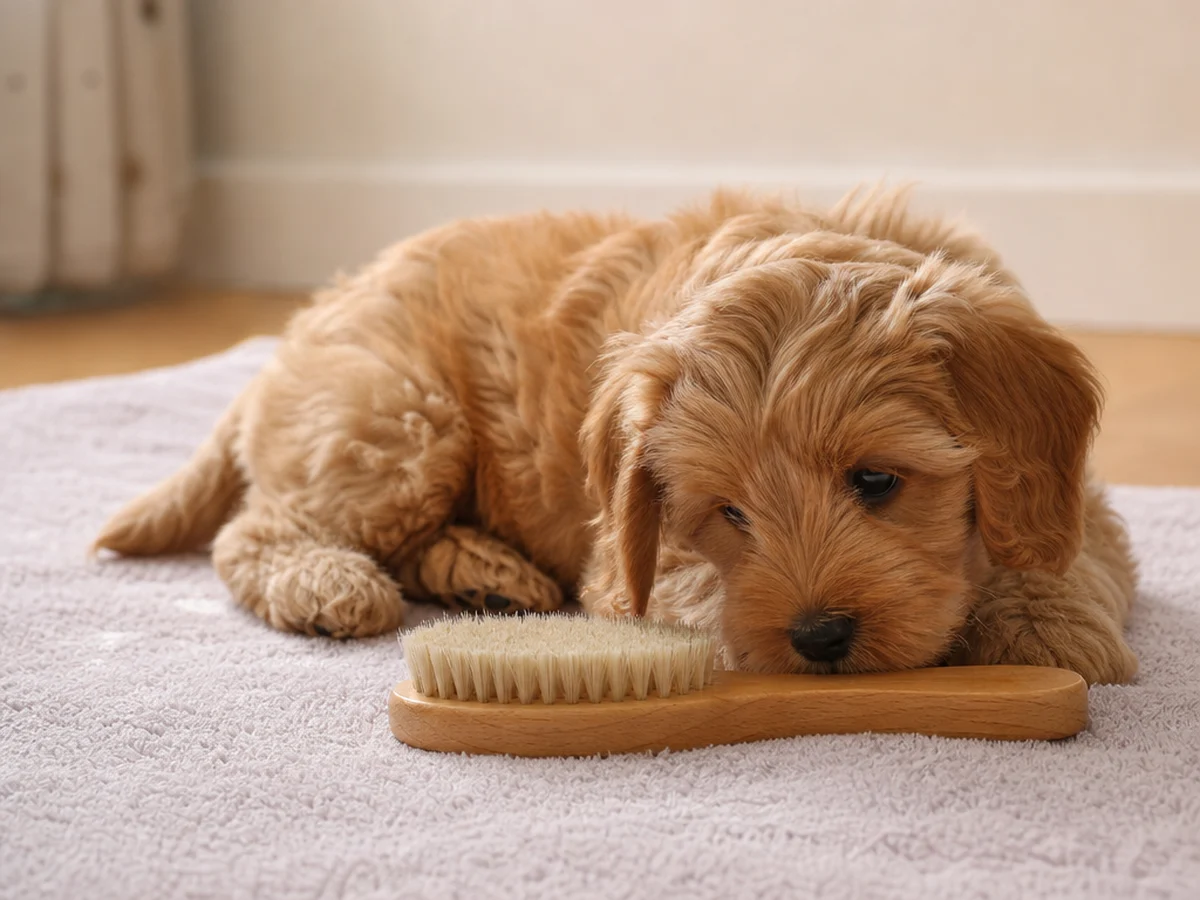
Puppy sessions should be tiny. Touch a paw, give a treat. Lift an ear, give a treat. Make one brush stroke on the shoulder, give a treat and end the game. If the puppy leans in for more, you have set the right pace. If they wriggle away, you asked for too much, so go back one step next time.
Do not expect daily brushing to prevent every tangle in a young puppy's coat. Owners report that daily brushing often does not. So the early goal is not a perfect coat. Instead, the goal is a puppy who sees the brush and the comb as the start of something good. Parent breed guidance also recommends early socialization, and brief, pleasant handling by other familiar people fits that advice well.
Stop each session while the puppy is still interested. Practice that ends on a high note gets a faster yes tomorrow.
Is Face Grooming Safe at Home for a Cockapoo?
It can be, if your dog already accepts having the muzzle, eyes and ears touched, and if you stop the moment either of you is unsure. The face is where a sudden head turn does the most harm, so the question is less about skill with scissors and more about how well your dog holds still for a reward.
Tools and Setup
Use blunt-tipped grooming scissors or a quiet trimmer, and introduce the tool well before you use it. Humane World notes that most dogs need time to get used to clippers, and that pretending to trim and then giving a treat builds toward calm trims. Do the same with your face tool: show it, treat, touch it to the shoulder, treat, then bring the sound near the face, treat.
Teach a chin rest first. Your dog places their chin in your palm and holds it there while you snip a tiny amount of hair. Reward the stillness, not the finished haircut.
When to Stop and Call a Groomer
- Stop if your dog flinches, pulls away or turns their head at the scissors more than once. Go back to the chin rest and treat practice before trying again.
- Call a groomer if hair around the eyes is matted to the skin, because working scissors close to the eyes is not the place to learn.
- Call your veterinarian rather than a groomer if you see redness, discharge or squinting, since those are health signs and not coat problems.
Do only a small part of the face per session. A tidy face trimmed over several days beats a rushed one.
A Cockapoo Must Simply Tolerate Grooming
Tolerance is a poor goal. A dog who merely puts up with the brush is already stressed, and stress usually shows up as squirming, mouthing, or hiding the next time you pick up the comb. Rewarded, gentle handling keeps dogs relaxed, and the same logic applies to grooming, as research on reward-based training shows. Gentle, rewarded handling suits a breed whose Cocker side may be sensitive.
Turn Brushing Into a Choice
Reward-based trainers use a cue to ask for a behavior, a marker to mark it and a treat to reward it, as the cue, marker and reward model describes. For grooming, the cue can be your dog stepping onto a mat or towel. Mark with a word like "yes" the moment they settle, brush one stroke, then deliver the treat. If your dog leaves the mat, the session pauses. If they come back, you continue. That is consent, and it makes the next session easier.
Signs to Pause
Watch your dog between strokes, because lip licking, yawning or looking away tells you the pace is too fast. A stiff body, a tense face or panting while the room is cool means they are uncomfortable and need a break, and refusing treats mid-session is a strong sign to stop and try again later with an easier step.
If you see these signs, shorten the next session and lower the bar, then rebuild.
Is Tail Work Always Off Limits on a Cockapoo?
No, but it is a touchy area for many dogs. Face, feet and tail are commonly sensitive places, so handle them with extra patience. If your dog tucks, spins or freezes when you reach behind them, assume the area is sensitive and teach it slowly. Feathering and tangles gather around the base and the back legs, so you cannot skip this area forever.
Go in small stages and advance only once your dog stays relaxed at the current stage:
- Rest a hand on the back, treat, and remove the hand.
- Slide the hand down toward the hips, treat.
- Touch the base of the tail for a moment, treat.
- Lightly hold the tail, treat, and let go.
- Make one gentle comb stroke through the hair near the base, treat.
- Add a second stroke, then a few more over several days.
If your dog backs away at any step, do not repeat it harder. Return to the last step they enjoyed, and add a better treat. Always work from the dog's side with your hand visible, never from a surprising angle.
Feet follow the same pattern. Owners report that long nails catch on things and make a dog cry, and that snipping the tips helped a lot. Practice with touch, treat and one nail at a time, and use a handling ladder like the one above.
Only Professional Grooming Can Prevent Mats
A groomer does the heavy work, but a groomer cannot stop mats forming in the weeks between visits. Owners who use a salon settle into visits about every six weeks. What happens at home between those visits decides whether the next appointment is a tidy trim or a shave-down.
Splitting the Work Between Home and Salon
Some owners have the groomer shave hidden knotty spots at each visit, so a simple weekly brush covers the rest of the coat. Others weigh the cost of regular salon visits and build a home grooming station instead. Both can work. If your dog's coat is very curly and mats fast, lean on a groomer for the deep work. If it is looser, home care with a slicker and a comb to the skin may be enough.
Bathing and Drying
Dry a damp coat thoroughly, because moisture left near the skin helps tangles form. Some owners use a mild baby shampoo and are happy with it. Some owners find drying takes hours, and some dogs run from the hair dryer. Teach the dryer as you would the trimmer: sound first at a distance, then treats, then closer. Towel-dry well to cut the drying time.
Call a groomer when a mat sits tight against the skin, when the coat is so tangled that a comb will not pass, or when your dog is too distressed to continue. Cutting at skin level at home risks nicking the skin. Book regular veterinary checkups as well, since skin problems can look like coat problems.
Two Weeks of Grooming Practice, Day by Day
This plan builds touch and tools in the first week, then adds face and tail work in the second. Keep every session short, brush daily, and end before your dog loses interest. If a day goes badly, repeat it rather than moving on.
- Day one: Set up a mat. Reward your dog for stepping on it, with no brushing yet.
- Day two: Add a hand sweep along the back with a treat after each sweep.
- Day three: Show the slicker brush, treat, and make one stroke on the shoulder.
- Day four: Brush the body in a few strokes, then follow with the metal comb on a small patch down to the skin.
- Day five: Handle the paws, one at a time, with a treat each.
- Day six: Brush the legs and belly, pausing at any sign of stress.
- Day seven: Do a full gentle brush and comb, with a high-value treat at the end.
- Day eight: Teach the chin rest and reward holding still.
- Day nine: Touch the trimmer or scissors to the shoulder, treat, no cutting.
- Day ten: Comb the hair around the muzzle and ears gently.
- Day eleven: Begin the tail ladder: hand on the back, hips, then the base, with treats.
- Day twelve: Add one comb stroke near the tail base.
- Day thirteen: Practice the dryer sound at a distance, with a treat for calm.
- Day fourteen: Run through the full routine, then decide whether you need a groomer or can keep going at home.
The point of all of it is a Cockapoo who sees grooming as a calm, rewarding routine. This breed's coat will not let you skip the work, and because a Cockapoo may inherit an eager-to-please, sensitive nature, patience can pay back quickly. Brush daily, reward often, and the coat will stay manageable between visits.
 Training basicsRecall for a Cockapoo Who Follows Their Nose
 BehaviorBalancing Fetch and Calm for a Ball-Obsessed Cockapoo
 BehaviorWhy Is My Cockapoo Barking for Attention? Quiet Ways to Ask