 Cockapoo
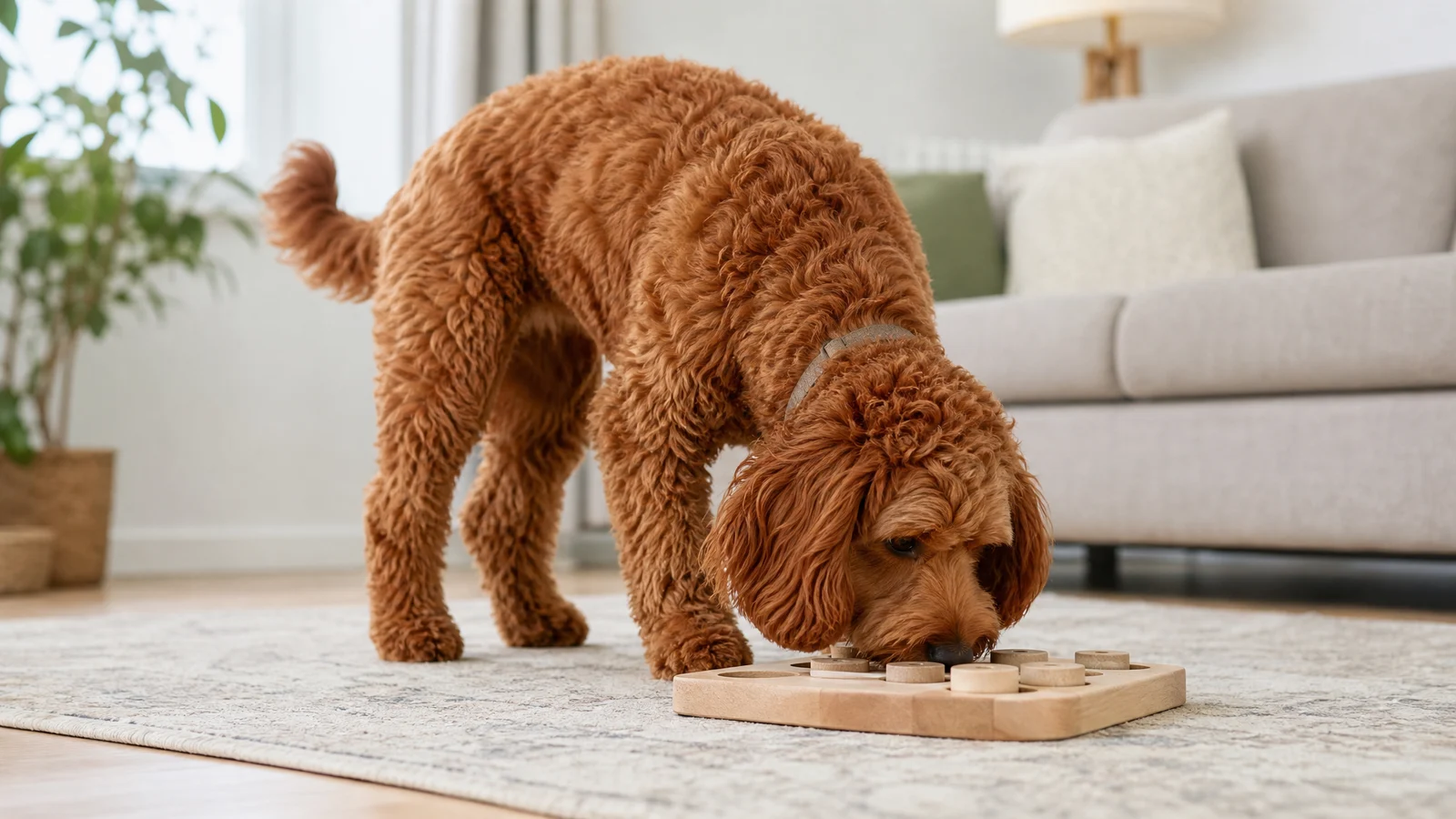
Some Cockapoos spend the afternoon working a puzzle feeder and sniffing out hidden treats, then fold up on the sofa by evening. Others have no job at all, so they shred cushions and bark at the window until someone gives in. Owners often credit temperament for the gap. We think the difference is mostly work.
That matters in this cross because the Poodle parent sits at the top of the scale for mental stimulation needs, while the Cocker parent earned a living with a sensitive nose. A bright dog with no assignment invents one, and the choices are rarely the ones you would pick.
Read on for a worked example with a ten-week puppy in an apartment, covering scent games, the dog sports that suit a Poodle-Spaniel mix, gentle agility foundations, when formal classes can begin, and what to do on rainy days.
Our Example Cockapoo Puppy in a Two-Bedroom Apartment
Everything below follows one illustration, not a sourced profile: a young Cockapoo puppy living in an apartment with an adult home for much of the day. Your puppy will differ in size, coat and temperament, and every one of those variations is welcome here. We use this setup because advice about enrichment tends to dissolve the moment you have to fit it between a hallway and a sofa.
What the puppy inherits is a gamble, and we treat it as one. A cross may take from either parent or from both, so the plan covers each side:
- From the Poodle side comes a very smart, very active temperament that is quick to please when training stays fun, plus an excellent nose that once earned the breed work as a truffle hunter.
- From the Cocker side comes a sensitive nose that found and flushed game birds, a wish to please people, and a real enjoyment of play.
- Both parents rate 4 of 5 for energy, yet the Cocker does not need a lot of exercise just to burn off excess, while the Poodle needs good exercise every day.
Size matters too. Cockapoos vary with the Poodle parent, so a smaller puppy and a larger one will differ in stamina and in what their joints should be asked to do. Treat every exercise figure, ours included, as a starting guess and adjust to the dog in front of you.
Now set the timeline. Some owners describe a hard stretch at around 5 to 8 months, and it is mostly barking and pestering, such as demanding attention and stirring things up, rather than aggression. Our guide to Cockapoo adolescent behavior covers that stretch in depth.
Many owners also say the dog changed a lot as they matured, and the change was large rather than slight. Some only notice real settling at around 1.5 to 2 years, and even calm adults have lively moments. Calm is a trend, not a switch.
Scent Games From Week Ten Toward Dog Sports
Nose work is the best first project for our example puppy, and the reason is practical. It needs no jumping, no equipment beyond tiny treats, and no steady legs, so a ten-week puppy can do it on the living room floor. Both parents bring a nose to the table, which means there is a fair chance the talent arrives already installed. We are not teaching a puppy to smell. We are giving the smelling a point.
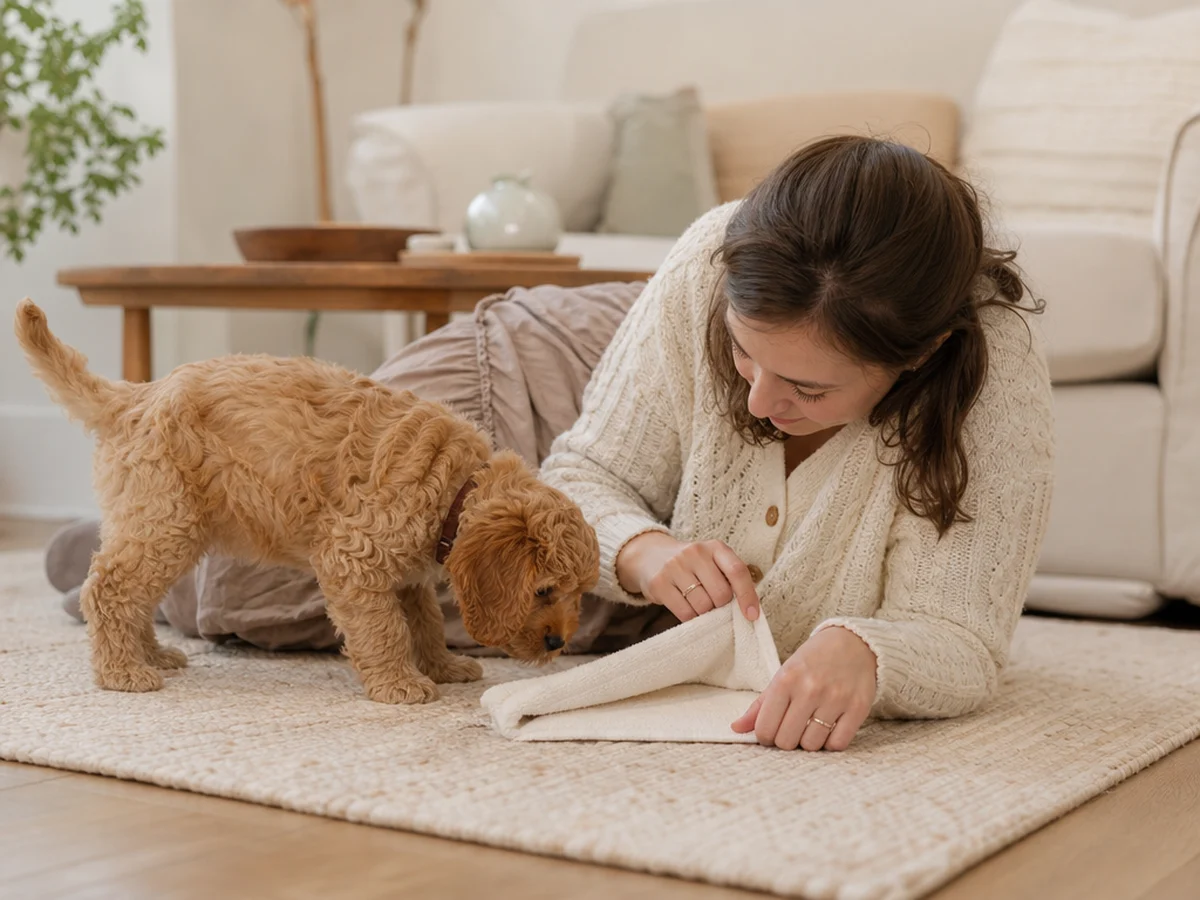
Work through these in order, a few minutes at a time, and move on only when the last step looks easy:
- Scatter a few tiny treats on a bare patch of floor and say find it as the puppy starts eating, until the cue means something.
- Drop a short trail of treats down the hallway so the puppy follows their nose from one to the next.
- Set out a row of open cardboard boxes and bait at least half of them with smelly treats, so the puppy finds the reward alone. Best Friends describes this setup for starting nose work.
- Hide a treat in an easy spot while the puppy watches, then move to spots they did not see.
- Carry the game into another room so the search skill travels.
Stay quiet while the puppy works. Pointing, repeating the cue and nudging them toward the answer all teach a puppy to wait for help, and independence is the whole value of nose games. Stop while they still want more. A short, successful session beats a long one that ends in wandering.
This is also your best answer to the pestering phase. Battersea lists scent games, training and puzzle feeders as help for boredom barking, and a game offered before the demands begin works better than one offered in response to them.
Which Dog Sports Suit a Poodle-Spaniel Mix?
Start with the evidence, which is thinner than the marketing. The Poodle parent enjoys and excels in agility, obedience and tracking, and the AKC puts that breed at 5 of 5 for mental stimulation needs, the top of a scale that ends at needing a job or activity. The Cocker scores 3 of 5, though that breed enjoys the challenge of performance activities and is best introduced by trying events to see what interests the individual dog.
Your puppy is a cross, so none of this is a promise. What the parents give us is a menu worth sampling, and this table lines the traits up with sports the example puppy could try.
| Sport | Parent trait it draws on | Fit for the example puppy |
|---|---|---|
| Nose work | The Cocker's sensitive nose and the Poodle's excellent nose | Starts at home from week ten |
| Agility | The Poodle's strength in agility and the Cocker's liking for performance activities | Foundations now, jumping much later |
| Obedience | Trainability of 5 of 5 for the Poodle and 4 of 5 for the Cocker | Builds from basic cues with little physical strain |
| Tracking | The Poodle's strength in tracking plus the shared nose | A natural next step after scent games |
| Trick training | The Poodle's people focus and the Cocker's wish to please | Works indoors on any day |
Common advice says to pick the sport that matches whichever parent your dog resembles. Looks tell you little about talent. A curly coat does not guarantee a Poodle's agility, and a long ear does not guarantee a Cocker's nose.
Run short tasters of several sports and keep the one your dog chases. Having trained this breed for many years, we would let nose work and tricks lead, because they cost little, carry no jump stress and quickly show what the puppy enjoys.
Foundation Agility for a Growing Cockapoo
Agility looks like jumping, but its foundations are mostly walking, turning and thinking. That suits a puppy whose body is still growing and a cross that may carry the Poodle's talent for the sport. Early agility should contain almost nothing a bored teenager would call a sport. Flat work, tunnels and body awareness build the dog you will later jump, and they do it without strain on young joints. Use a non-slip surface, which matters on apartment floors.
Flat Work and Targets
Teach the puppy to put all four paws on a mat or folded towel, then to pause there, rewarding with a marker word and a treat. Walk them over a broomstick lying flat on the floor, then over a board or ladder laid on the ground. The goal is a puppy who looks where their feet are going. Reward each calm pass and stop before they tire.
Tunnels and Body Awareness
Drape a blanket over two chairs or open a large cardboard box, show a treat at the far end and reward the exit. Add a gentle bend so the puppy must curve through. For body awareness, reward standing with the front paws on a thick book, then switching feet, then walking around a low object. Each step is slow, quiet and kind to a young body.
Keep it cheerful. Dogs from reward-based schools were calmer after training, with fewer stress signs and lower cortisol rises, in a 2020 PLOS ONE study covering 92 companion dogs. If the puppy hesitates at anything, go back a step and make it easier.
When Can This Puppy Start Formal Dog Sports?
There is no single starting gun for organized sports, and we distrust any page that claims one. Home games begin now. Puppy classes for early socialization are recommended for the Cocker parent and are a sensible choice for the cross as well. Jumping, hard turns and competition depend on how far the puppy's growth has progressed, and the person qualified to judge that is your veterinarian, who should see the puppy regularly anyway.
Event organizers also set their own age minimums and rules on mixed breeds, so check those before you plan anything. Here is the example puppy's likely timeline, with the usual caveat that dogs vary:
- From week ten, run scent games and tricks at home, plus a puppy class for manners and socialization.
- Around 5 to 8 months, expect barking and pestering. Meet it with trade games, chew outlets and rewards for settling, and keep agility to flat work and tunnels.
- Toward one year, ask your veterinarian whether joints and growth are ready for any low jump heights before you add them.
- Between 1 and 2 years, many owners see the real calming, some only at around 1.5 to 2, and a class that asks for long focus starts to go well.
Do not enter a trial to cure a wild adolescent. A dog still pestering the household is not ready to work in a crowded ring, and steady practice at home is what builds the dog who will be. Even then, expect the occasional lively day. Keep rewarding settling and keep outlets available.
Puzzle Feeders and Trick Training for Rainy Dog Sports Days
Rain exposes the weak spot in most plans, since a dog who relies on a long walk for calm falls apart when the walk is canceled. Mental work is not a replacement for physical exercise, but puzzle games and scent work do tire a dog mentally. So keep up indoor play and a short wet-weather outing, then fill the gaps with brain work like this:
- Offer an easy puzzle feeder the puppy can solve in seconds, then raise the difficulty. A smart cross may master one puzzle quickly, so rotate them.
- Teach spin and touch, where the nose meets your hand, by luring with a treat and then fading the lure.
- Teach a bow, rewarding the moment the front end dips.
- Teach the name of one toy, then add a second and ask for one by name.
- Play tug with rules, starting and stopping on cue so the puppy learns to switch on and off.
Poodles have long been tied to the European circus tradition, and tricks suit a people-oriented cross because the audience is you. Brief sessions work best, so stop while things are still going well. If a trick stalls, shrink the step rather than repeating it louder. A puzzle feeder handed over before the usual window-barking hour often saves you the argument.
Tonight's Single Scent Game for Your Cockapoo
It all comes down to one idea. A Cockapoo is a bright, people-focused cross with at least one parent bred to use a nose, and the dog needs work to do, or they will choose their own. Supply the work and evenings go calmer, the adolescent months go easier, and the sports options stay open as the dog matures. For more daily ideas, see our guide to Cockapoo exercise and mental work.
So skip the grand plan and do one thing tonight. Pick one room and hide five treats around it, in easy spots at first, such as a visible corner of the rug or beside the sofa leg. Show the dog one treat, say find it, and let them search for the rest without help.
When all five are found, end with praise and a calm few minutes. Tomorrow, hide them somewhere a little harder.
 Training basicsCockapoo Training From Day One: A Reward-Based Guide
 Training basicsWhy Is My Cockapoo So Clingy? Teaching Calm Time Alone
 Exercise and jobsIs Your Cockapoo Hyper? Exercise That Helps Them Settle